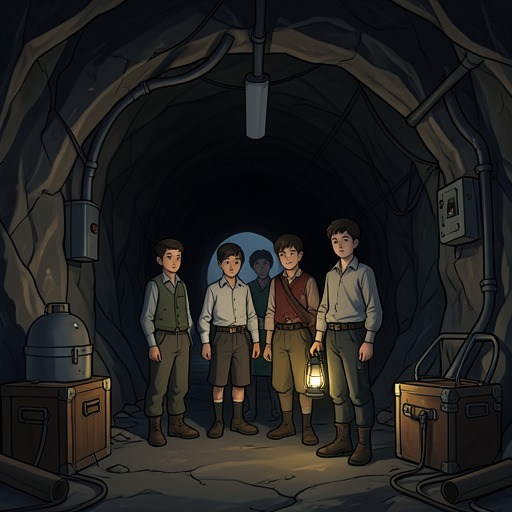
The boys dig an underground fort and the mound collapses
The Master Butchers Singing ClubThe boys dig an underground fort and the mound collapses, an episode in which Markus turns grief into a place he can enter, shape, and temporarily control. What begins as solitary digging at an abandoned construction site becomes a clandestine boys’ project, marked by secret oaths and the gradual construction of a chamber beneath a mound of earth. The work offers Markus quiet and purpose, but the rain makes the ground heavier and less stable. When he remains inside to finish reinforcing the passage, the mound gives way with him still beneath it.
Discovery and First Excavation
A year after Eva’s death, Markus becomes fascinated by excavation. Behind the pine and oak woods, a mile or two from the butcher shop, lies the abandoned site of a planned grand house: its basement has been dug, but the owner ran out of money before construction began. A rotting shed remains nearby, and the excavated dirt has been piled into a high mound. Markus finds the place while wandering with a slingshot and stones. He jumps into the basement, struggles to climb back out, then explores the shed, where he finds rusted cans and an ax head with a broken handle.
The mound attracts him as more than a convenient heap of soil. Lying on its newly raised, weed-sprouting surface, Markus feels as if the earth shifts beneath him. At its foot, he presses his ear to the packed hillside and hears his own heartbeat. He begins to dig with the ax head, initially without a settled plan. As the hole deepens into a shallow, bowl-shaped hollow, he recognizes that he is making a space large enough to shelter his body. Its heavy black earth contains fragile snail and fingernail-sized clamshells; beneath an overhang, he finds the dirt soft and comfortable enough that he does not want to move, despite hunger.
The hollow also brings him close to the moment he could not bear at Eva’s funeral. He remembers holding a clump of dirt over her coffin and freezing instead of releasing it; Franz had pried open his fingers and shaken the soil onto the lid. Now, alone inside the earth, Markus lets his tears fall and continues to carry Eva in his thoughts. Digging gives his grief a physical setting: he can sit within the ground, return to the memory, and imagine that something he anticipates may be found by digging further.
The Secret Fort
Markus cannot keep his discovery to himself. He tells Emil and Erich about the imagined fort, tunnel, stronghold, and cave, embellishing the plan as his excitement grows. He proposes using boards from the abandoned shed and branches from the woods to reinforce the excavation. He also devises an initiation: the boys swear an oath of secrecy, made solemn by hot wax dripped onto the insides of their wrists.
The project expands into a shared routine after school. The boys steal shovels, carry excavated soil away on sheets taken from clotheslines, and cache bread, hard apples, nuts, potatoes to roast, and sausage ends. They work after dark by lanterns taken from barns and candles taken from their mothers’ bureaus. Roman Shimek even obtains candles from the Catholic church, provoking an angry sermon from Father Clarence Marek. The Waldvogel boys no longer attend church after their mother’s death, despite Tante’s efforts to bring Fidelis and the children back. They take pride in their secrecy and transgression, making wax signs on their wrists, swearing oaths, and licking the rusty ax head.
The group eventually narrows to a determined core: Markus, the twins, Emil and Erich, Grizzy Morris, and Roman Shimek. They build a substantial entrance from an old wagon box, add a horseshoe to a lintel made from a beam beneath the sagging shed, and reinforce the first stretch of the tunnel with boards torn from the shed’s walls. About twenty feet of belly-high passage leads to the chamber. The room begins small; Markus scrapes it wider with a hoe blade, while the boys use a stolen square of canvas to drag the dirt out.
Markus does more than his share of the labor. While other boys rest or try to smoke dried plants rolled in newspaper, he digs and hauls soil without reproaching them. Entering the doorway and crawling into the hill’s dark interior gives him a deep satisfaction: in the chamber, he can hear his blood and heartbeat in the intense quiet. After working there, he is calmer and sleeps through the night for the first time since losing Eva. The secrecy is aided by the dry early-November weather, which lets most of the dust be brushed from their clothes before they slip home. Delphine sometimes leaves for the evening, and Fidelis, occupied with work or company, does not notice the boys so long as they come back apparently safe.
Rain, Collapse, and Immediate Stakes
As the weather grows colder, the boys keep enlarging the room until one can kneel inside, then stand, and eventually several can squeeze in. A cold November rain lasts three days. It floods ditches, sewers, the river, and sloughs, and fills the abandoned house’s basement with water. When the boys return after the skies clear, they find damage: some boards have sagged and the hill has eroded where they climbed to keep lookout. The tunnel, dug at a slight upward angle, and the room farther inside remain deceptively dry. Above them, however, the saturated earth is many times heavier than it was when they began.
The boys set to work repairing the damage. Markus commands them to bring boards so they can reinforce the structure, enjoying the grown-up, professional sound of the word. He takes a crowbar from his father’s tools, and the boys pry more boards from the shed. Wet clods are harder to remove than dry soil, a warning that the ground has changed, but they continue clearing the entry. The chamber is only partly supported by a flimsy framework. As daylight fades, Roman says he has to go home. Markus answers that he will leave as soon as he has reinforced the last section.
Markus is still inside when the others leave the entrance and head back toward the shed for one more board. He wedges a board into the ceiling by feel, relying on the walls’ reassuring dryness and the silence of the chamber. The boys outside then sense something in the hill and turn to look. With a dull, interior whomph, the high dome sags. Their astonishment delays them; it takes several minutes for them to remember that Markus has not come out.
Significance in Markus’s Grief
The fort gives Markus a form of refuge that is at once physical, private, and communal. Its earth recalls the grave where he could not let go of the dirt in his hand, but the excavation reverses the helplessness of that funeral moment: here, he can dig, make a hollow, and decide who may enter. The secrecy oath and the hidden chamber also register the boys’ estrangement from adult and religious authority after Eva’s death. Their defiance is not only play; it grows from a sense that they have been forsaken and that prayer did not protect their mother.
The same ground that offers shelter becomes dangerous when its conditions change. The tunnel survives the rain at first, giving the boys false reassurance, while waterlogged earth grows heavier overhead. Markus’s insistence on completing the reinforcement keeps him inside at the moment the mound collapses. The episode thus turns his grief-shaped refuge into a perilous enclosure: the earth can hold his memories and quiet him, but it cannot be mastered simply by digging deeper.